Method
Overview video
Catching a flying object with a legged robot requires tight coordination between perception and locomotion under strict time constraints. Many existing robotic systems estimate object trajectories in a fixed external frame and then plan interception motions, treating robot motion as a disturbance to be compensated for. We instead formulate catching as egocentric interception, a control strategy that operates in the robot's moving frame without requiring a stable world frame from SLAM or external sensing infrastructure.
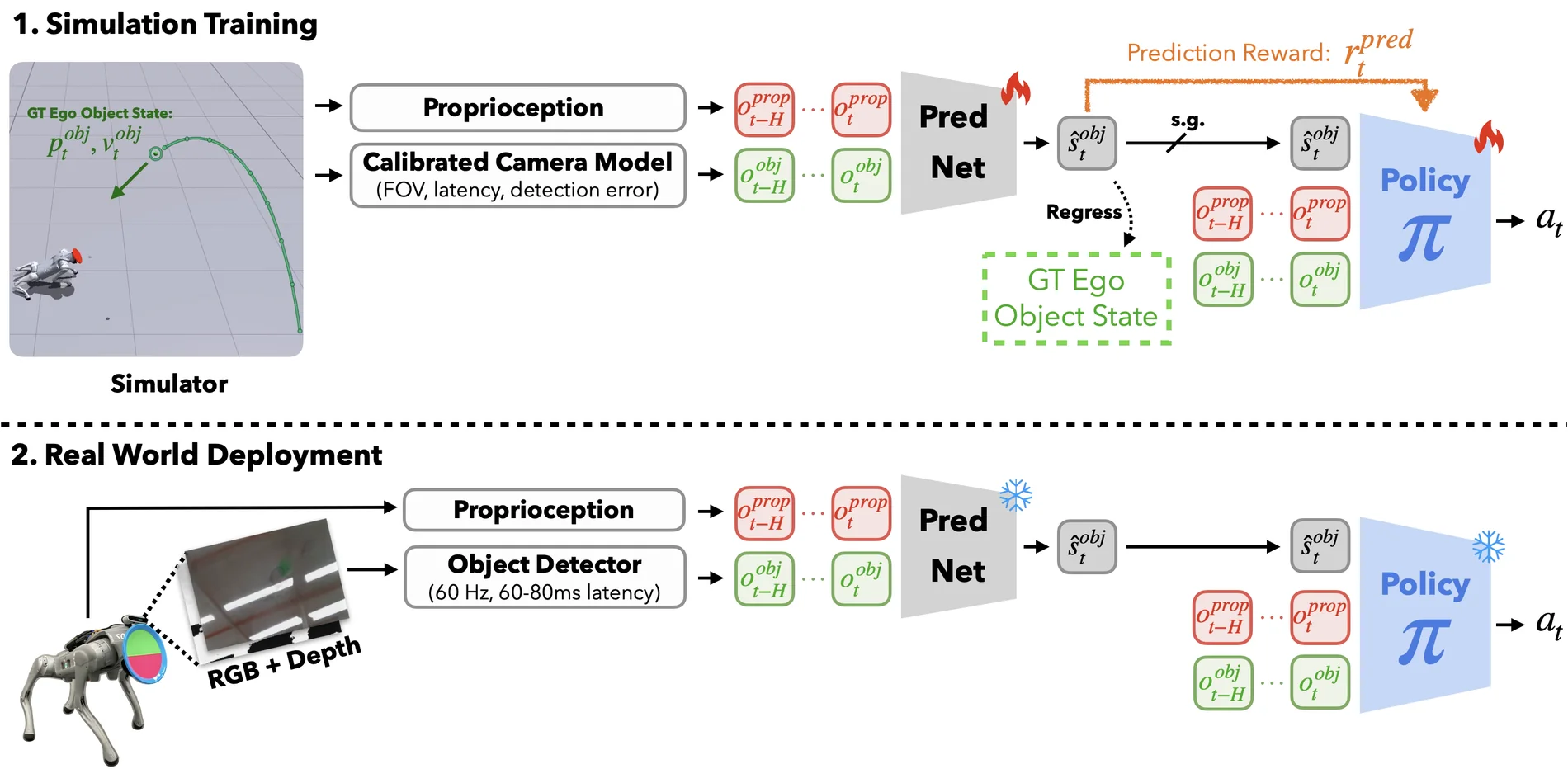
We present a unified visuomotor framework that jointly optimizes interception success and egocentric prediction accuracy of object motion from onboard observations, enabling emergent leg–eye coordination. The policy is trained in simulation using a calibrated sensor model that captures latency, depth error, and motion-dependent detection noise. Our method achieves ~90% success in simulation, outperforming a baseline policy trained with decoupled teacher–student distillation. The learned policy is validated zero-shot on a real Unitree Go2 quadruped with onboard RGB-D sensing, demonstrating robust legged interception.
Objects are thrown from ~3–3.5 m with 0.85–1.5 s flight times. Every clip shows the policy running zero-shot from simulation, with all sensing onboard. The slow-motion clips were shot at 240 fps and play at 0.125× real time; the rest are full speed.
Our policy uses onboard RGB+D perception.
Policies are trained with PPO and an asymmetric actor–critic in a massively parallel Legged Gym environment.
Leg–eye coordination emerges from jointly optimizing interception and egocentric prediction: the robot turns to hold the object in its narrow field of view while repositioning to intercept.
@article{egointercept2026,
  title   = {EgoIntercept: Egocentric Object Interception with a Quadruped Robot},
  author  = {Anonymous Authors},
  journal = {Under review},
  year    = {2026},
  url     = {https://EgoIntercept.github.io}
}